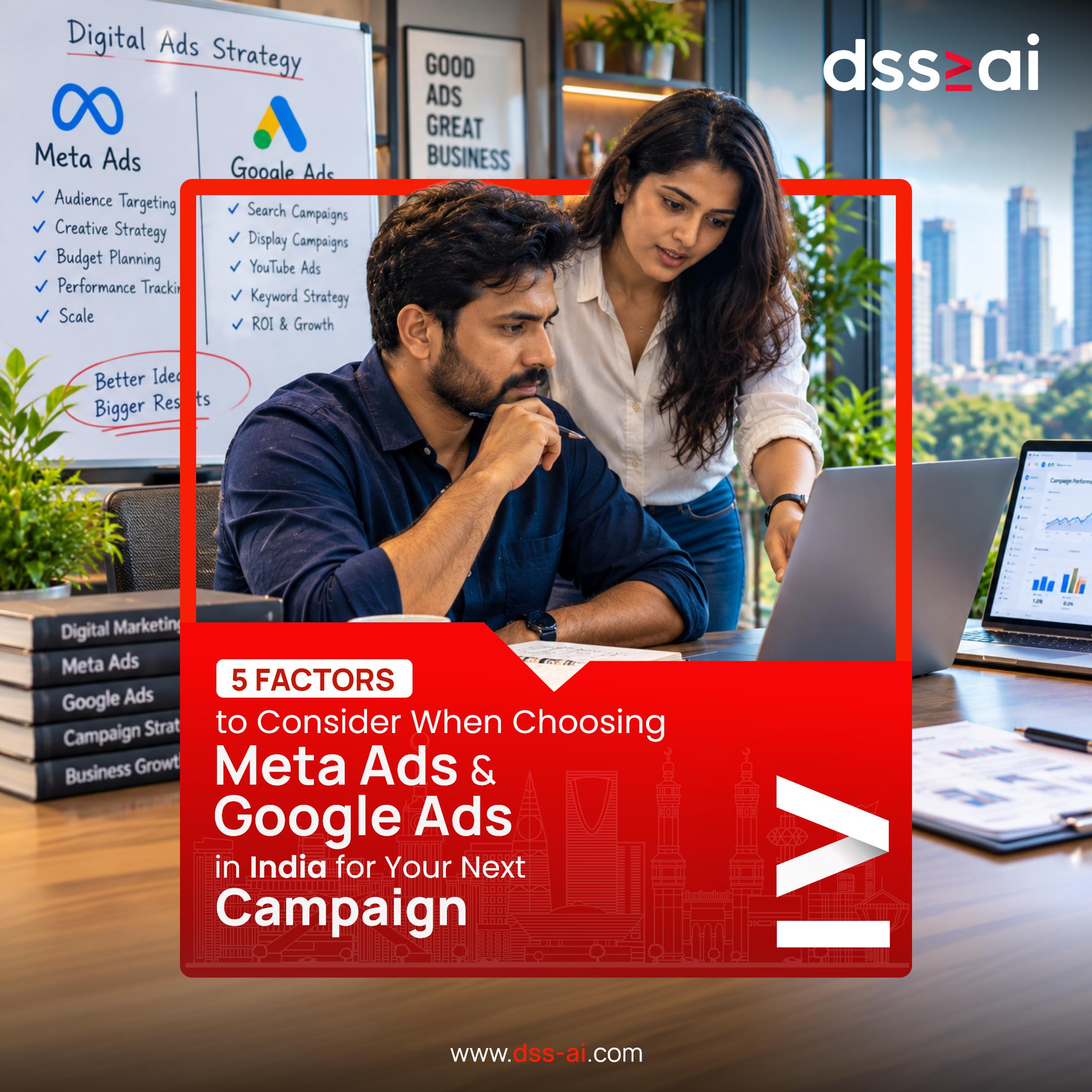
Meta or Google—which deserves your ad budget?
The answer depends on audience behaviour, search intent, campaign goals, budget and customer journey. Discover the five factors before making your next move.
A high performing ad campaign does not begin with a platform. It begins with an understanding of who you want to reach, what they want and when they are ready to act.
The advertising landscape in India has become fragmented and competitive. India’s digital advertising market reached approximately ₹94,700 crore in 2025 growing 26% year over year and accounting for 63% of total advertising revenue (Source: EY). Businesses are competing for attention and intent. Advertising decisions now demand greater strategic precision.
Meta Ads and Google Ads in India serve different moments in the customer journey. The former can help businesses reach audiences through visually driven environments such as Facebook and Instagram. The latter can capture users who are searching for a product or service. Before deciding where to spend, businesses must understand whom they want to reach and how those audiences behave online. Also they should have a strong paid advertising strategy.
Who Are You Trying to Reach and How Do They Search?
The right platform begins with the right audience.
Businesses need to evaluate their audience behaviour before investing in PPC advertising in India. They can identify the customers’ age, place, interests, purchasing pattern, device behaviour and brand awareness. The diversity of regional markets, languages and income segments is significant for Indian campaigns. The same product may require completely different advertising approaches across Indian audiences.
Meta Ads
It becomes useful for businesses that need to introduce products, generate awareness and stimulate consideration. A Meta Ads agency in India helps to reach audiences based on characteristics and behaviour. So, visually driven businesses in fashion, beauty, food and lifestyle can benefit from creative social advertising such as Facebook ads and Instagram ads.
Google Ads
Google describes search campaigns as a way to reach people actively searching for specific products and services. Professional services, B2B services and high-intent searches may have stronger opportunities around search behaviour. Such businesses can choose Google Ads and benefit from the services of a Google Ads agency in India.
Knowing who your audience is only answers half the question. The next consideration is whether that audience is already searching or still needs a reason to search.
Make your next ad campaign count with dss-ai.
Call us at 8921946736 / 8921944992 or drop an email at info@dss-ai.com for more information.
Are You Building Demand or Capturing Existing Intent?
Some customers search because they already want something. Others need to see the right message before they realise they want it. This is where the difference between Meta Ads and Google Ads in India lies. India’s social media usage is increasing. Users spent approximately 880 billion hours on social platforms in 2025, up from 801 billion hours in 2024 (Source: Storyboard 18).
When a user is already looking for a solution, they may search, for example ‘best digital marketing agency in India’, ‘buy running shoes online’ etc. Google Search has the capability to capture the demand because ads can show up when people are searching for keywords that relate to it.
Demand generation is the creation of awareness and interest before the search. The advertising ecosystem of Meta can be utilized for product introduction, communicating benefits and consideration. Meta can also support conversion-oriented campaigns, while Google has awareness and discovery-oriented formats beyond search.
Once demand and intent are understood, the next question becomes more commercial: what exactly should the campaign deliver?
What Do You Want Your Campaign to Achieve?
A campaign should never be judged by how many people saw an advertisement. It should be judged by what those interactions contribute to the business.
Meta Ads: From attention to conversion
A Meta Ads campaign can support stages such as brand awareness, reach, engagement, website traffic, lead generation, conversions and remarketing. In this context, creatives, audiences and objectives must work together. A campaign optimised for awareness shouldn’t necessarily be evaluated using the same metrics as a sales campaign. Metrics can include reach, impressions, engagement, landing page views, leads and conversions.
Google Ads: From search intent to measurable action
Google Ads campaign can be aligned with objectives such as sales, leads, website traffic and local actions. Google recommends defining the objective before choosing campaign settings and campaign type. Search campaigns can be relevant for lead generation, inquiries, service bookings and purchases. Google Ads management should therefore involve more than simply adjusting bids. It can include search term analysis, keyword optimisation, negative keyword filtering, landing page alignment and conversion tracking.
Where Can Your Budget Create the Strongest Return?
The objective is not to spend more. It is to make every unit of media investment work harder.
Meta’s model can provide substantial audience reach. Budget efficiency can depend on audience size, creative quality, frequency, engagement and conversion signals. Creative fatigue is an important consideration. A Meta Ads agency can continuously test hooks, headlines, visuals, reels and CTAs.
Meta cannot be judged only by cost per click (CPC). A lower CPC is not necessarily a better outcome if traffic doesn’t convert. So it is important to consider cost per qualified lead, cost per acquisition, conversion rate, ROAS and customer value.
Simultaneously, Google budgets are strongly influenced by keyword competition, search volume, industry, location, bid strategy and conversion rates. A highly commercial search may be more valuable even if the click costs more. Here, ongoing optimisation of search terms, bids, campaign structure and conversion data is important.
This distinction brings us to the most important question: which platform actually fits the way your customers move from discovery to decision?
Which Platform Fits Your Business and Customer Journey?
Your customers do not move through your marketing strategy in neat, platform-specific boxes, and your advertising shouldn’t either. So, how should businesses select the ideal platform for campaigns?
Meta Ads: Influencing the earlier stages
Meta Ads can be relevant when the business needs to introduce a relatively unfamiliar product, build brand awareness, demonstrate a visually compelling product or create consideration. It is also helpful in engaging new audiences and retargeting website visitors. The potential customer journey goes from discovering and engaging to considering and converting. Businesses related to fashion, beauty, food and education can benefit from Meta Ads.
Google Ads: Converting existing intent
Google Ads in India can be relevant when customers search for a specific service, compare providers, search for prices, have an urgent need or already understand the product category. They may first search for a product or service they need. They then explore their options, compare offers and click an ad that matches their intent. This will potentially lead to a conversion.
The question at dss-ai is not simply whether Meta Ads or Google Ads should receive the budget. The meaningful question is how each platform can contribute to the customer journey and commercial goal. Our digital marketing campaigns in India focus on answering this question.
Conclusion
Choosing between Meta Ads and Google Ads in India is ultimately less about choosing a platform and more about choosing the right path to the customer. While Meta Ads stand for visual storytelling and demand creation, Google Ads focus on search intent, demand capture, high-intent discovery, comparison and performance-driven campaigns such as Performance Max.
For some campaigns, Meta may carry the greater strategic role. For others, Google may be central. And for businesses with multi-stage customer journeys, the strongest approach may involve both. dss-ai helps businesses to select the ideal platform based on business objectives and customer behaviour.
Make your next ad campaign count with dss-ai.
Call us at 8921946736 / 8921944992 or drop an email at info@dss-ai.com for more information.
FAQ
Should Indian businesses pick Meta Ads or Google Ads for the next campaign?
There is no universal choice. Meta Ads have a clear edge in terms of discovering the audience, visual appeal and building demand around a product or service. Google is great at finding customers who are already looking for what you’re selling. It all depends on what one is looking to achieve with their marketing campaign and the kind of customers they’re targeting.
When should I go for a Google Ads agency for my business?
A Google Ads agency becomes useful when customers search for your products or services. It could help to set up and manage search network campaigns including targeting relevant keywords, managing bids and measuring conversions in order to maximise budget value.
Is an Instagram ads agency right for me if I need to build brand awareness?
Yes, because you can attract the target audience and provide them with visual information in the form of Reels, Stories, carousels, images and other types of Instagram ads. This is especially important for those products for which the discovery process is associated with visual perception.
Can Meta Ads create demand when customers are not actively searching?
Yes. Meta Ads have the potential to create demand for products or services even if the customers are not searching for them. A combination of a strong creative, the right audience and remarketing can take a business through the funnel starting from discovery to consideration and then to conversion.
Should businesses simultaneously run Meta Ads and Google Ads?
These platforms can work complementary to one another where a customer journey involves both discovery and active search. Meta can acquire awareness and consideration, whereas Google can capture the search intent. The decision to run ads on both channels should be dependent on the goals, audiences and budgets.